Portugal is a sweet country, and by this, we mean we have a lot of sweet pastries! We also have the sweetest people, of course!
If you’re visiting Portugal, chances are you’ll quickly run into an impressive lineup of sweet Portuguese pastries staring back at you from café windows. Today, we’re here to help you make sense of them… and hopefully tempt you into trying a few.
Last week, we explored the Ultimate Guide to Savory Portuguese Pastry. Today, it’s time for the sweet ones.
Sweet Portuguese Pastries: A Way of Life
Two things will happen to you after a visit to Portugal:
- The first one is the burning desire to return for another visit;
- And the second one, a few extra pounds!
All due to the delicious Portuguese gastronomy and sweet pastries. Take note of these words, you will remember them when you leave.
As you walk through Porto (or any Portuguese city), you’ll notice cafés and pastelarias everywhere. They’re part of our daily rhythm: breakfast, mid-morning coffee, afternoon snack, or a post-dinner espresso. We go there to eat, yes — but mostly to gather, talk, and catch up.
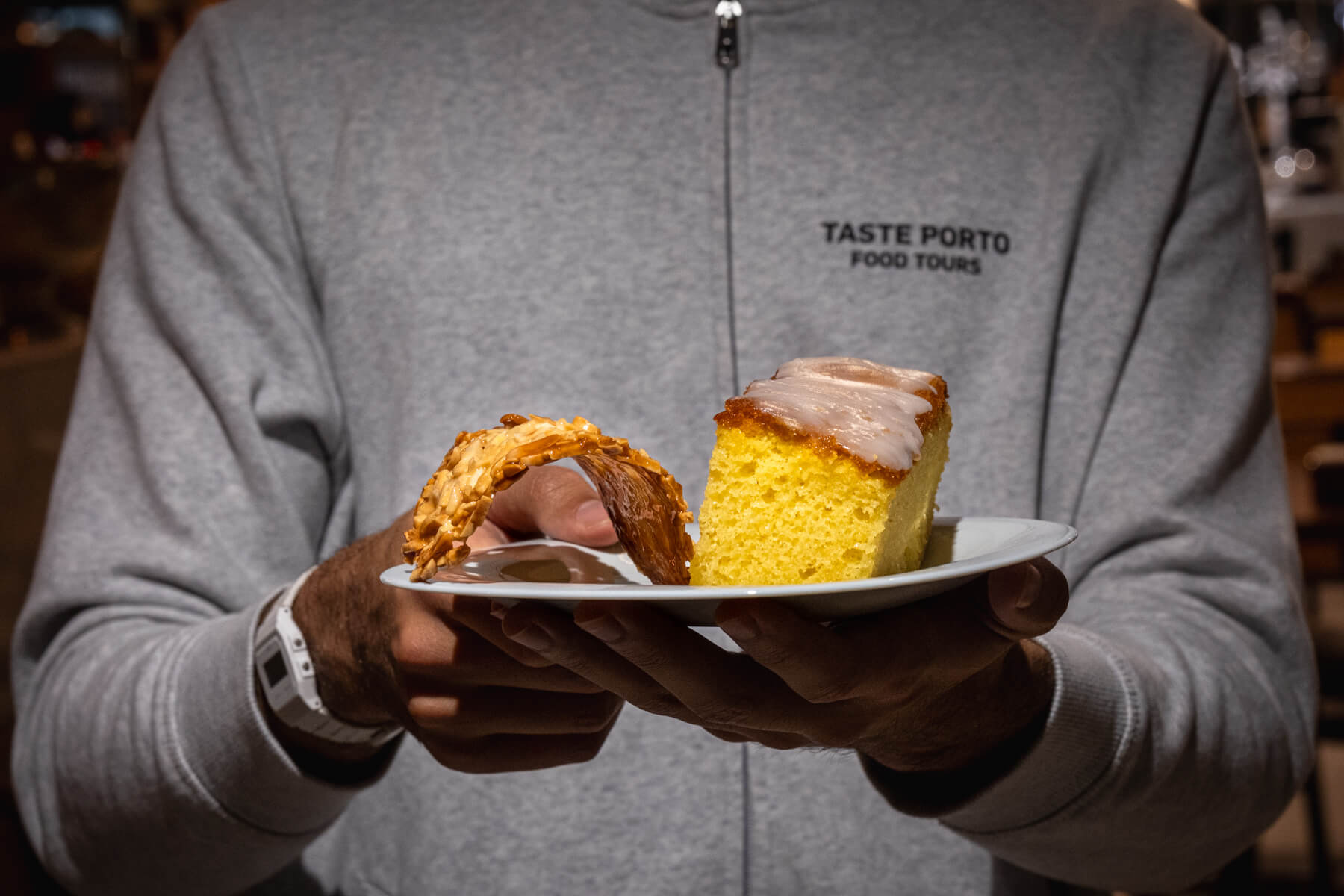
A word of advice: visiting a country is all about getting to know and experience the culture. With that in mind, embrace the Portuguese way of life and take a break from all of your exploring. Sit, relax, treat yourself to a nice cup of coffee, and one of the sweet pastries we are about to explain.
How to order sweet Portuguese pastries
Ordering is easy: everything is on display, so you can simply point. The tricky part? Knowing what’s inside. That’s where we come in.
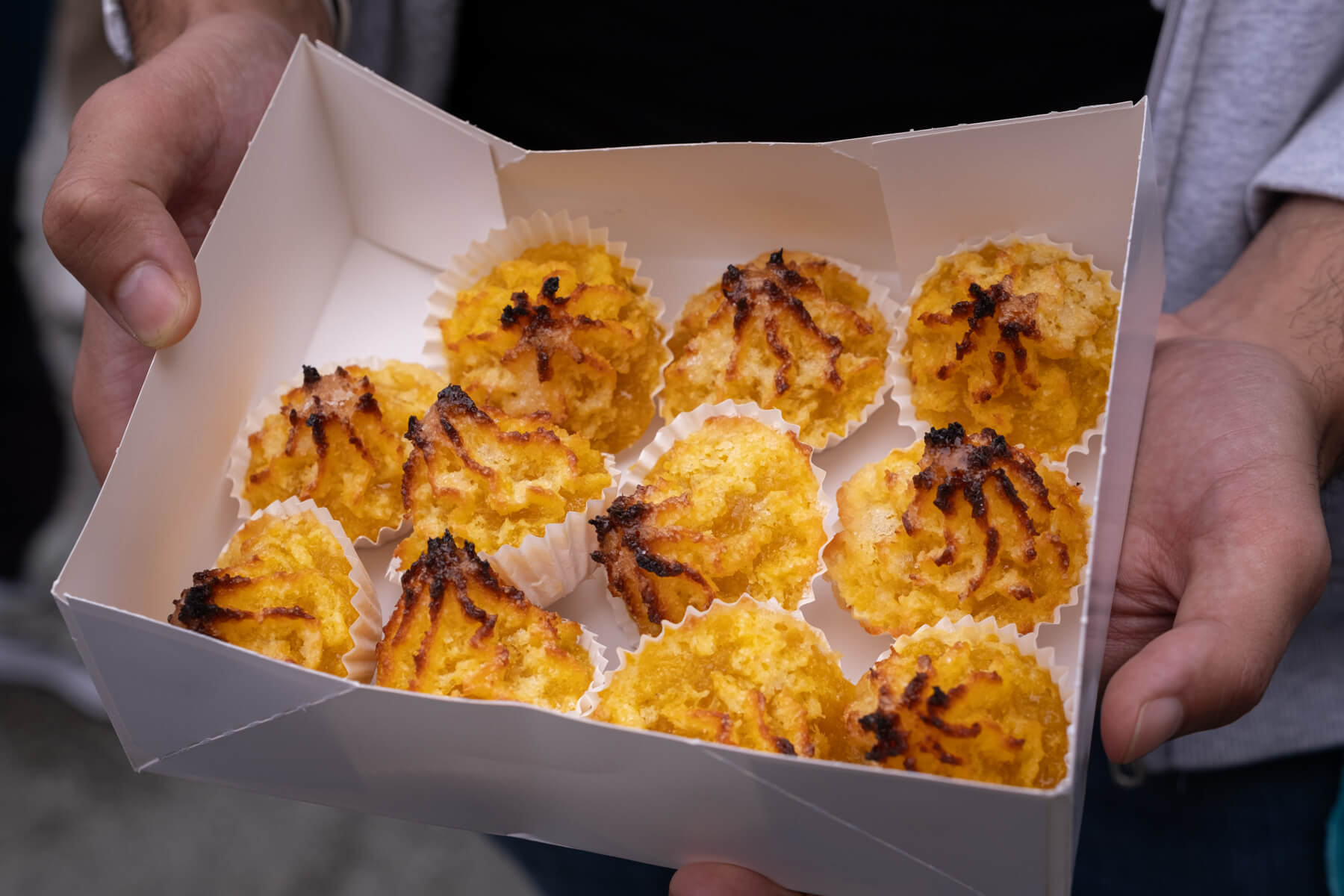
We can’t fit every sweet pastry into one guide, but here are some of the most common (and beloved) ones you’ll find. Oh, and we bought miniatures – which look the same as the full-size versions – because we “had” to eat them afterward and we don’t want to get fat(er)!
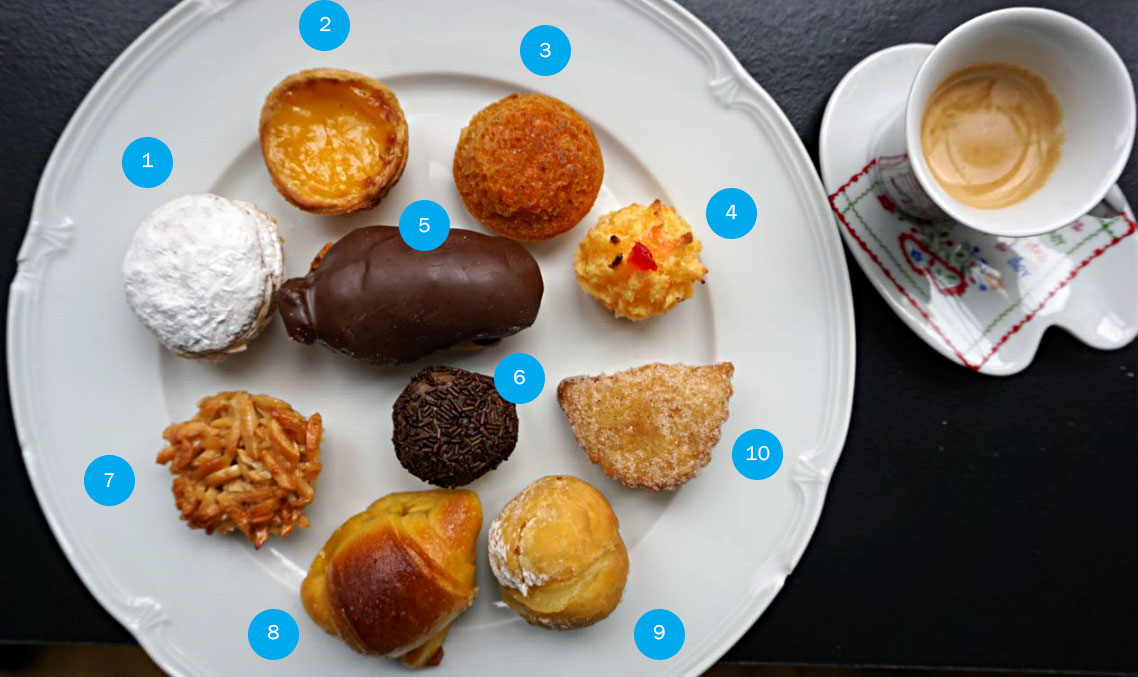
Sweet Portuguese Pastries you should know
In Portugal, we often use the word bolo, which literally means cake, to refer broadly to sweet pastries. Each one has its own name, but you’ll hear bolo used often. Here are a few classics:
- 1. Pastel de Feijão / Bean Tart: This typical sweet Portuguese pastry is made of a white bean puree contained within a flaky, baked crust. It is commonly presented with powdered sugar sprinkled on top. Created in Torres Vedras in the late 1800s, it is as simple as it is delicious.
- 2. Pastel de Nata / Custard Tart: It is named Pastel de Belém due to its origin in the Belém district of Lisbon. However, it can only be called by that name if it is produced in the Fábrica dos Pastéis de Belém, where it was created back in the 18th Century. Since this one was made fresh in Porto, we call it a pastel de nata. This is probably the most widely known and popular Portuguese pastry, isn’t it? It’s made of delicious custard baked inside a thin, multi-layer, flaky crust and should be eaten with powdered cinnamon sprinkled on top. Spoiler alert: You’ll find it hard to eat just one.
- 3. Queque de Cenoura / Carrot Cake: Carrot cakes, as well as orange and lemon cakes, are very common in Portugal. This version resembles a muffin and contains carrots, of course, sugar, eggs, olive oil, and flour.
- 4. Pastel de Côco / Coconut Tart: These tarts can be spotted right away on the window, they have a distinctive pyramid shape and are usually topped with a candied cherry. They contain shredded coconut, sugar, and eggs.
- 5. Eclair: The widely known French pastry. Adopted into the Portuguese cuisine a long time ago, it is made with light pastry dough – choux dough – filled with egg custard inside and covered with chocolate on top. You won’t find the same number of flavor variations as widely as in French, except in a few specialized shops such as Leitaria da Quinta do Paço.
- 6. Brigadeiro: The famous Brazilian pastry has also acquired its place in the offer of Portuguese pastry shops. The brigadeiro is made with condensed milk, butter, cocoa powder and is coated with chocolate sprinkles.
- 7. Tarte de Amêndoa / Almond Tart: Also known as the Portuguese caramelized almond tart. There is a legend that tells us how the almond trees came to grow in Portugal. It is said that an Arab prince, concerned that his wife, who was from a northern country, could become sad from missing the snow, ordered the planting of these trees so its blossoming could create the illusion of fields covered with snow. We don’t know if this legend is true but we do know it’s a very sweet story, just like this delicious almond tart. It contains butter, flour, eggs, milk, and naturally, almonds and there is no almond tart that can rival this one!
- 8. Croissant: Well, this is probably the most famous pastry in the world and it was also adopted and adapted to our culture. The Portuguese croissant is similar in shape to the French one, but that is where the similarities end. The dough was completely reinvented: instead of something like and airy, expect something with a heavier, doughy consistency, closer to a brioche. You can eat the classic version or experiment with the versions containing fillings of custard or chocolate. We eat them for breakfast or a mid-afternoon snack and we even make it into a sandwich, with cheese and ham inside. Yes, we do treat ourselves very well when it comes to food.
- 9. Bola de Berlim / Berlin Ball: This is one of the most popular pastries in the country and also among visitors. It is filled with an egg yolk based cream and its outside is fried and covered with sugar. A bit like a mini-doughnut though lighter. You can find it everywhere, but during summer you can often find street vendors selling it right on the beach.
- 10. Clarinhas: This is one of the many conventual – meaning coming from a convent – sweets in Portugal. These kinds of sweets date back to the 15th century, a period when sugar came into the gastronomic tradition of the convents. Sugar and eggs, as you now know after reading about the previous sweets, are the stars of these pastries. Clarinhas contain these ingredients, of course, but it is filled with chila, a jam made from a type of squash. We promise it won’t let you down!
Sweet Portugal
Like we said before, if you have the opportunity, take a few minutes to go inside and sit at one of our traditional pastry shops. Sit, ask for your coffee and pastry and watch as Portugal happens before your very eyes. These sweet Portuguese pastries are available in regular and small sizes, so if you want to discover your favorite one first, go for the miniatures and then treat yourself to the full-size version. Enjoy!
With love,
The Taste Porto Foodie Team